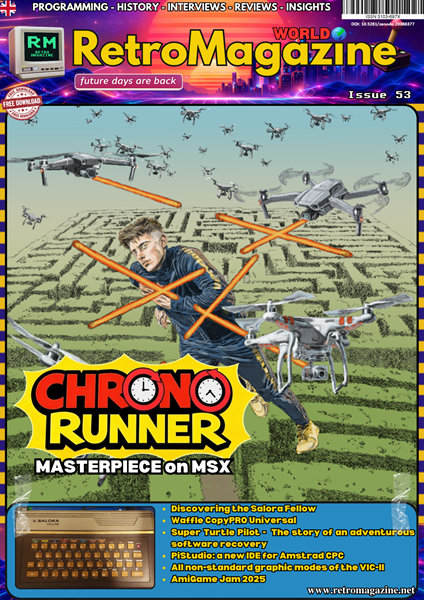
People involved in the preparation of this issue of RetroMagazine World (in no particular order):
- Francesco Fiorentini
- Carlo Del Mar Pirazzini
- Marco Bergomi
- Eugenio Rapella
- Jari Jalonen
- Takahiro Yoshihoka
- Roberto Lanciotti
- Ingrid Poggiali
- Chiara Carrara
- Alex Fridman
- Daniele Brahimi
- David La Monaca
- Stefano Tognon
- Roberto Del Mar Pirazzini
- Tommaso Pitturru
- Giampaolo Moraschi
- …
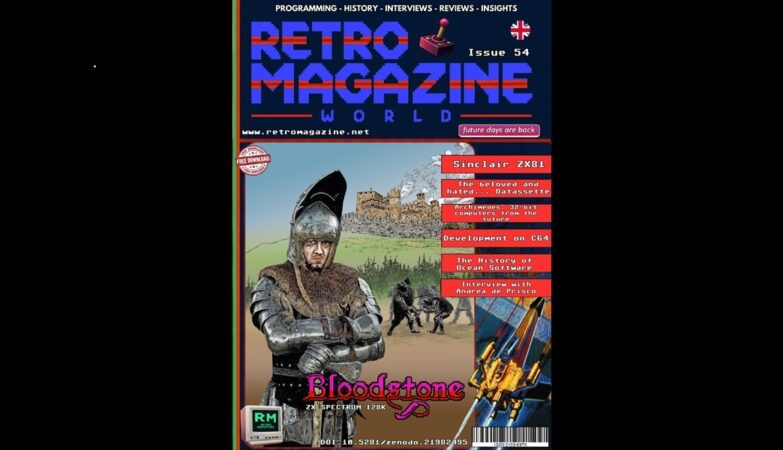
- Cover image: Giuseppe Mangini
- Cover layout: Carlo N. Del Mar Pirazzini
Editorial by Francesco Fiorentini – “With retrocomputing, you can’t go wrong…”
Retrocomputing, as you well know, has never been merely a nostalgic look back. It’s a journey that brings us unexpected discoveries every day, as if time, instead of flowing in a straight line, were coiling back on itself, leaving a new treasure around every corner. And just when we think we’ve seen it all – that computer, that chip, that hard-to-find peripheral – a manual forgotten in an attic pops up, a cassette with unreleased software, a programming book that rewrites the rules of what we thought we knew. With retrocomputing, you can never go wrong because the archaeological dig never ends: there’s always something to uncover, and the surprise is part of the fun.
But the real turning point of recent years is something else. While the outside world debates whether today’s games are “better” or “worse” than those of thirty years ago, something wonderful is happening within our niche: dozens of new titles, developed by enthusiasts for vintage platforms, often surpass the average quality of the original productions from the ’80s and ’90s. This isn’t heresy; it’s a fact. The new games for Commodore 64, Amiga, ZX Spectrum, or Amstrad CPC draw on decades of experience, rediscovered techniques, and tricks that no one had even imagined back then. They have the authentic flavor of the era, but the maturity of those who have studied every single flaw in the hardware and turned it into a strength.
The third pillar, perhaps the most fascinating, is the hardware. No longer just repairing, but reinventing. A flood of creatives, engineers by passion, hobbyists with a knack for soldering are building a solid bridge between yesterday and today: accelerator cards, alternative floppy drives, Wi-Fi devices for machines that didn’t even have a modem, modern cartridges for vintage consoles. It is a bridge that does not look back, but propels retrocomputing into the future, making these machines not only alive, but up-to-date, connected, capable of interacting with the contemporary world without losing an ounce of their soul.
The issue you hold in your hands is the perfect example of this journey. Inside, you’ll find precisely this explosive mix: the story of a recent discovery—software once thought lost and now brought back to light—reviews of new games that would have put the developers of the golden age to shame, and the presentation of hardware that transforms your old computer into a modern machine. And, as always, by the end you’ll be left wanting more, wondering what’s in store for the coming months and years.
Because with retrocomputing, you can never go wrong. And the next surprise is probably just around the corner.
Summary:
- PiStudio: a new IDE on CPC
- Salora Fellow
- Sinclair QL: Sir Clive’s quantum leap
- NES Zapper
- WaffleCopyPro-Universal
- Discovering Kyvos by George Sokianos
- Kaleidoscopes in many flavours (C64)
- A magic trick (C64 beginners)
- Super Turtle Pilot (story of a weird recovery)
- All non-standard graphic modes of the VIC-II
- Building game maps (C64)
- Digital preservation and code enhancing
- AmigaOS 3.3 – The evolutions of the OS
- Interview with Richard Farrell aka Vyper68
- To collect or to accumulate?
- Apple turns 50: half century of “Think Different”
- Nintendo’s (almost) forgotten mascots
- AmiGame Jam 2025 – Return to arcade
- Andoria: the return of the GDR on Apple II
- Crystian and The Lost Crystals (C64)
- Ghosts’N’Goblins (Amiga AGA)
- Mappy (Amiga AGA)
- Akalabeth 1000 (Sega SG-1000)
- Wee Ninja (Atari 5200)
- Space Bash: Contact!! (MSX 16KB)
- Celeste (Amiga)
- Randoom (Commodore Plus/4)
- Chrono Runner (MSX)
- Black Castle II (Gameboy)
- Echodrome (Amiga)
- Dragon View (SNES)
- Escape From PETSCII Planet (C64)
- Junk Runner 64 (N64)
- Soul Blaze (Dreamcast)
- Zezito and The Lost Stars (Acorn Electron 32K)
- Burgertom (Atari Jaguar)
- Tony Do It! (C64, Atari 8-bit)
- Wings Of Fear (Amiga AGA)
- Bubble Buddies (C64)
- Miracle Boy in Dragon Land (Atari ST)
- Curse of The Pharaoh (C64)
- Axis (C64 – Plus/4)
- Gravity Duck (C64)