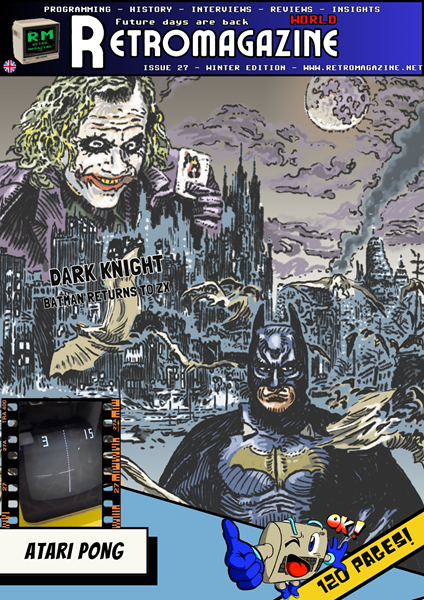
People involved in the preparation of this issue of RetroMagazine World (in no particular order):
- Carlo N. Del Mar Pirazzini
- Daniele Brahimi
- Francesco Fiorentini
- Paolo Cattaneo
- Roberto Del Mar Pirazzini
- Giampaolo Moraschi
- Leonardo Miliani
- Takahiro Yoshioka
- Barbara “Morgana” Murgida
- Eugenio Rapella
- Javier Gonzalez
- Marta Rossmann
- Gianluca Girelli
- Marco Pistorio
- Ksenia Kamash
- Michele Ugolini
- Evan Granovitz
- Alberto Apostolo
- Ingrid Poggiali
- David La Monaca
- Bimbomillo
- Fredrik Ramsberg
- Cover image: Giuseppe Mangini
- Cover layout: Carlo N. Del Mar Pirazzini
Editorial by David La Monaca – “Digital scans = Permanent memory”
It’s just after 11:30 p.m. Tomorrow I have to wake up early for a work commitment that has been scheduled for some time. I’m already in bed, but after a stressful day spent in front of the computer, sleep is slow in coming. In fact, it just doesn’t want to come at all. In the dim light of a lamp, the room seems to take on a dark amber color. With an almost automatic gesture, I reach for my tablet on the bedside table and open the app that accesses my home NAS, part of which is dedicated to the nostalgic world of retrocomputing, an archive full of technical articles, manuals, books, and magazines published mainly in the 80s and 90s. I select the ‘Sinclair’ folder, then ‘Mags’, and open issue 24 of Sinclair User, the English edition from March 1984. The summary lists various articles for the ZX Spectrum and a presentation/review of the then-new jewel of the company founded by Sir Clive, the Sinclair QL. After skimming through a few programming articles and the special feature on the QL, Morpheus’ welcoming arms finally envelop me.
The next morning, on my way to a business meeting, I think back to the “door of time” that I was able to open the night before, to a world that no longer exists, but which I can access whenever I want. And I ask myself: who should I thank for this fantastic opportunity? Obviously, the publishing house that published the magazine in those years, but also the work of a single enthusiast, an organized group, or the entire retrocomputing community that carried out the digitization. Certainly, I am not the first to discover the importance of digital scanning. But here I would like to emphasize a few key points that highlight the great usefulness of these efforts made by groups of passionate enthusiasts.
Preservation of historical knowledge: digital scanning allows us to preserve knowledge related to the technology of the past, documenting how hardware and software have developed over the decades. After so many years, this cultural and technical heritage is in fact at risk of disappearing.
Universal accessibility: with digitization, anyone, anywhere in the world, can access rare materials without having to physically own a hard copy.
Preservation of technical documentation: manuals and magazines often contain crucial technical information, such as wiring diagrams, hardware specifications, and programming procedures, which enable the restoration and maintenance of old computers and consoles.
Preservation of software and languages: Many programs and games were distributed with listings and source code published in magazines or manuals. Their digitization is essential to preserve vintage software and programming practices from those years.
Cultural memory: Magazines from the 70s, 80s, and 90s offer a unique insight into the lifestyles and aspirations of the time, especially in relation to the evolution of computing and gaming.
Emulation support: Scans contain useful documentation for emulator developers, allowing for greater accuracy in the reproduction of vintage consoles and computers.
Recovery of lost content: many games and applications from the past were never digitally distributed and, without scans of manuals and magazines that mention them, would risk being forgotten or irrecoverable.
Preserving the memories of a generation: for many enthusiasts, digital scans represent a gateway to their childhood or adolescence, materials that fuel memories and nostalgia, significant aspects of retro-gaming.
Educational and teaching resource: digitized materials can be used for courses on the history of computing, digital culture, and even to teach the basics of programming through historical examples, making learning more engaging.
Preventing the risk of physical loss: paper deteriorates over time. Digitization ensures that this information is preserved beyond the physical life of the original documents, protecting it from accidental destruction or deterioration.
For all these reasons, digital scanning is an extremely valuable activity for safeguarding the technological and cultural memory linked to computers and consoles of the past, making available a heritage that would otherwise be at risk of disappearing. So I invite you too to think about it and, when you pick up your tablet late at night to read a manual, book, or magazine from the past, think about how you can repay all those groups that spend time and resources fighting the battle of time to give us pieces of the history of our beloved retrocomputers. Especially those who do so in a totally selfless manner and with the sole purpose of sharing and universal dissemination.
Note: this editorial and all the contents were first released in Italian in 2024 – ref. issue 49-IT
Summary:
- Atari PONG
- Atari 2600 – Tecnologie AI…
- The SPECTRUM
- Il Nintendo 64
- Donkey Kong su PC128 Olivetti Prodest
- Il C64 incontra l’Intelligenza Artificiale
- Zena
- Commdore 64 – BASIC V2
- Inform 6 – Tutorial 4
- To boldly go where no SID has gone before…
- Il peso del Tetris
- Giappone 25^puntata: Gachagacha…pon!
- Fireteam Rogue per Super Nintendo…
- Firenze Vintage Bit 2024
- Quinty (SNes)
- Escape 2042 (Jaguar)
- Kudzu (GB)
- Zephyr’s Pass (GBC)
- King’s Quest VI (Atari ST)
- Spelunky (C64)
- Dark Knight (ZX)
- Hayato’s Journey (MD)
- Super Dassalo Land (GBC)
- Black & White (NEXT)
- Data Man (NES)
- Ruff in Trouble (Atari 8bit)
- Super Mario Bros Mini (GBC)
- Super Mario Eclipse (GameCube)
- Tony Montezuma’s Gold (C64/…)
- Jester (NES/SNes)
- Dr. Dangerous (Amiga)
- Parasol Stars (Switch)
- Portal Buster (C64)
- Binary Battle (C64/…)
- Shift (C64/…)
- Metal Slider Glory… (Super Famicom)
- Qyxar (Coleco)
- Pokettohiro! (GBC)
- Spanky’s Quest (GB)
- The Curse of Lies (MSX2/…)
- Lunar Lancer (GB)
- Tiburoncy (C64)
- Aliens Neoplasma 2 (ZX/…)
- Twist of Souls (Atari 8bit)
- Chimney Man (MSX)
- Back to the Future II (C64)